In 2025, Cowtopia continued to travel — not as a fixed workshop, but as a living facilitation practice.
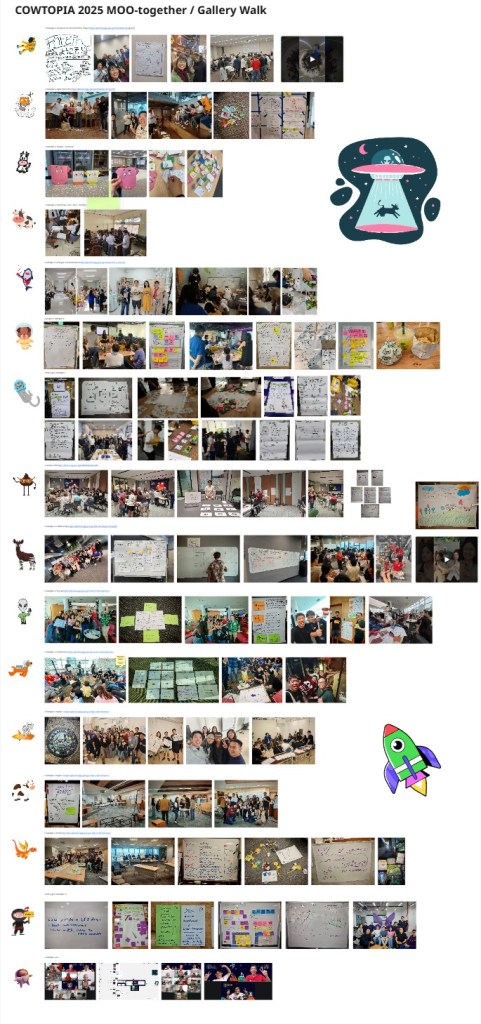
Across the year, we facilitated 16 Cowtopia sessions in community gatherings and organisational spaces. Different rooms. Different expectations. Different constraints. Yet one question kept resurfacing:
What do teams reveal about themselves when pressure, ambiguity, and time collide?
Cowtopia did not offer answers.
It offered conditions.
And within those conditions, teams showed us patterns — of leadership, collaboration, value, avoidance, care, and adaptation — often faster and more honestly than in “real work” settings.
Cowtopia as Practice (Not a Game)
By 2025, Cowtopia had moved well beyond being “a serious game”.
It functioned as a diagnostic mirror for team behaviour, a container for observing leadership under constraint, and a rehearsal space for tension, conflict, and choice.
The cows, the chaos, the boards, the rules — these are scaffolding.
What matters is what people do when that scaffolding starts to wobble.
Again and again, we noticed that teams rarely struggle with rules.
They struggle with alignment, trust, and ownership of decisions.
Cowtopia makes those struggles visible — quickly, and without blame.
What Surprised Us in 2025
What surprised facilitators most this year was not the chaos — but what chaos revealed.
A simple invitation to draw a cow surfaced deep authenticity.
People who were confused and people who were thinking often looked the same.
Different teams responded very differently to similar conditions and knowledge.
Chaos triggered parts of ourselves we didn’t always expect.
Some discovered that the calmest place was not at the edge, but at the heart of the storm.
Others noticed how easily seriousness softened when play was introduced — even among those who initially resisted the narrative.
Across sessions, it became clear:
helping teams see themselves more clearly is often the real starting point for clarity.
And quietly, we also noticed the work maturing —
14 facilitators showing up across the year, the highest number we’ve seen so far.
Moments When Teams Clearly “Saw Themselves”
These moments were often subtle, not dramatic.
When teams realised the game was not a competition.
When no cows were launched — and disappointment became reflection.
When participants moved between embodied reflection spaces: clear, confused, in control, frozen.
When decisions were made without a captain — and ownership surfaced.
When silence replaced scrambling, and teams reorganised without instruction.
Often, it was only after the game ended that insight landed —
when teams realised what they had optimised for, and what they had overlooked.
These moments reminded us:
reflection is not an add-on — it is where the learning lives.
What Shifted for Us as Facilitators
In 2025, something sharpened.
Facilitators consistently used less direction and less explanation — by choice.
We intervened less.
We told less.
We solved fewer problems on behalf of participants.
Instead, we invited more.
We paused more.
We trusted teams to make things up within loose boundaries.
Many facilitators noticed a move away from “King / Queen” or “Consultant” modes, and toward Warrior, Jester, or quiet Observer — especially during Earth Council moments.
Cowtopia taught us again that facilitation is not about steering outcomes, but about protecting attention, holding space, and knowing when not to act.
Threads for Moo Secrets (Draft)
Several threads became unmistakable this year:
- In play, we grant ourselves permission to be both ourselves and a different version of ourselves (Jodie)
- Awareness precedes behavioural change
- Chaos reveals patterns — it does not create them
- Reflection, not correction, unlocks learning
- Increasing our capacity for observation opens new paths of possibility (Jodie)
- Facilitation is a deeply relational practice
These insights will be expanded through stories, diagrams, facilitator notes, and experiments inthe Moo Secrets work in progress.
Questions We’re Carrying into 2026
As Cowtopia continues to evolve, these questions remain alive:
- How do we design reflections that move beyond insight into sustained behaviour change?
- How might Cowtopia translate into online or hybrid spaces?
- What would mini-Cowtopias look and feel like?
- How do we support non-gamers — especially senior leaders — to step into play without dilution?
- What does full-embodiment, no-materials Cowtopia look like?
- How do we bridge the “play aha” into everyday workplace behaviour?
- How might Cowtopia travel into more diverse communities — in Singapore, the Philippines, and beyond?
- What does large-scale Cowtopia require — spatially, energetically, relationally?
These are not problems to solve yet —
they are edges to listen at.
Looking Ahead
Cowtopia will continue to evolve — not by adding complexity, but by deepening practice.
In 2026, the intention is to:
- refine facilitator awareness
- document lived insights
- strengthen post-play reflection
- and continue using play as a doorway into serious conversations
For now, we pause —
with gratitude for the facilitators, teams, and cows who helped us learn this year.
And perhaps, somewhere out there, an astro-cow with many kinds of poop is already preparing for the next mission.
Thank you to 33 Cowtopia facilitators who have been with us since Day 1 and 1000 players who have landed with us on Mars
Michael Ong
Ian Pestelos
Andre Tan
Ketut Sulistyawati
Kwok Chung Yew
Alvin Zhang
Lee Jun Lin
Solihin Jinata
Mulyadi Oey
Jerome Bourgeon
Tze Chin Tang
Jocelyn Ke
Laxman Murugappan
Soma Mazumder
Jeremie Benazra
Mihaela Danciu
Yong Lin
Christopher Leow
You Hui Tay
Jia En Koh
Jodie Loi
Raven Chai
Sylvia Ng
Yap Geok Hui
Tomomi Sasaki
Maureen Chen
Abel Maningas
Adhitya Nugraha
Rachel Cheang
Carol Lim
Clement Ng
Nicole Wang
Quang Nguyen

 COWTOPIA